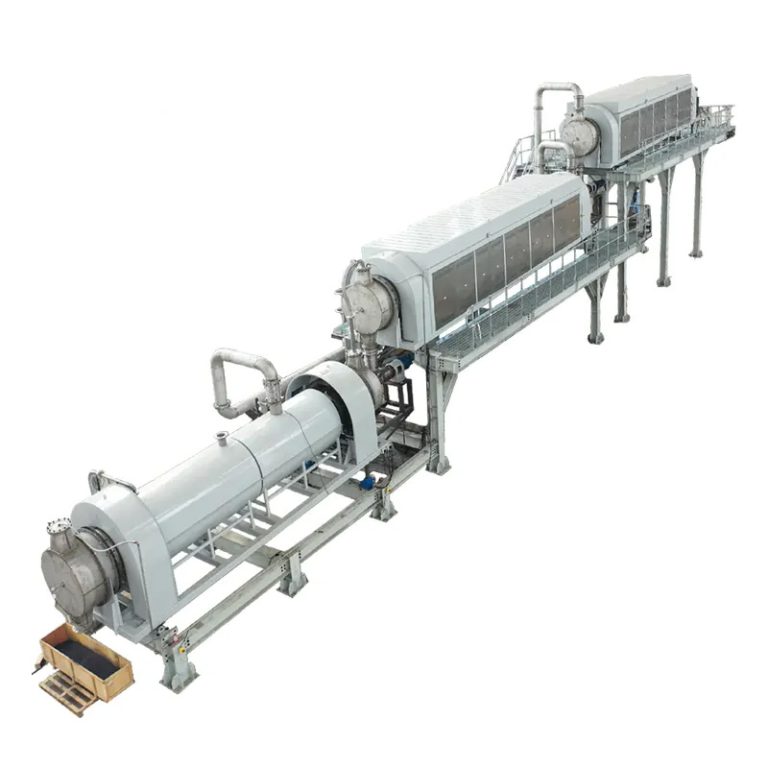
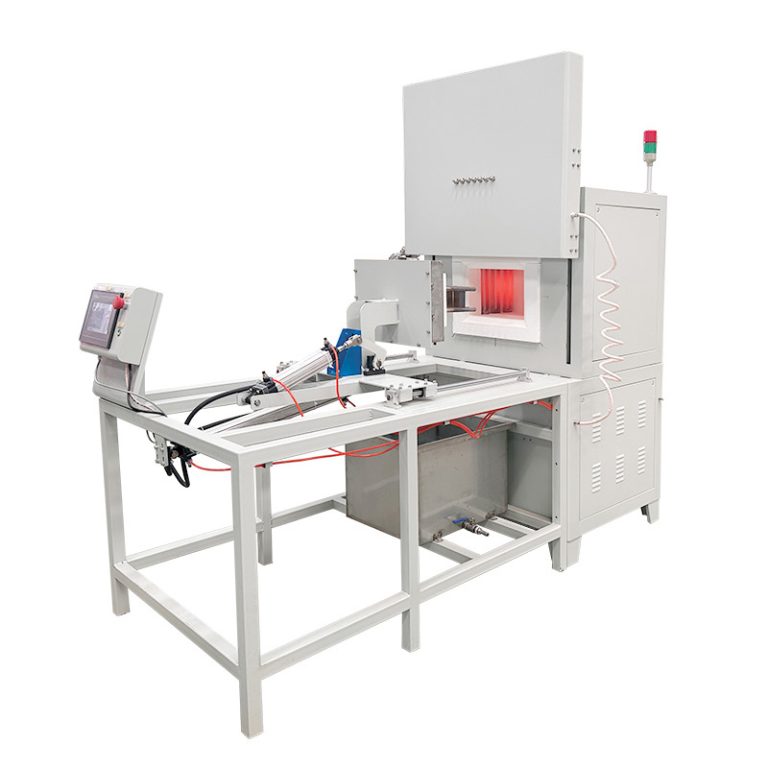
Luoyang Anjing Intelligence Equipment sinn e weltwäite Leader an Héichtemperatur elektresch Uewen



The Importance of CVD in Tube Furnaces
CVD is important in Rouer Uewen because it provides a controlled environment for depositing thin films and advanced materials. By combining precise temperature control, regulated gas flow, vacuum or controlled pressure, and a clean reaction tube, a CVD tube furnace enables more uniform, repeatable, and high-quality material growth.
ech. Aféierung
The importance of CVD in tube furnaces has grown rapidly with the development of graphene, carbon nanotubes, semiconductors, 2D materials, advanced ceramics, and other functional materials. Unlike a conventional heat-treatment furnace, a CVD tube furnace must precisely control not only temperature, but also gas composition, pressure, precursor delivery, and reaction-zone conditions.
For researchers and manufacturers, choosing the correct CVD tube furnace can directly affect deposition uniformity, material purity, process repeatability, and production efficiency. This article explains why CVD is important in tube furnaces, how the process works, and which furnace features matter most for advanced material applications.
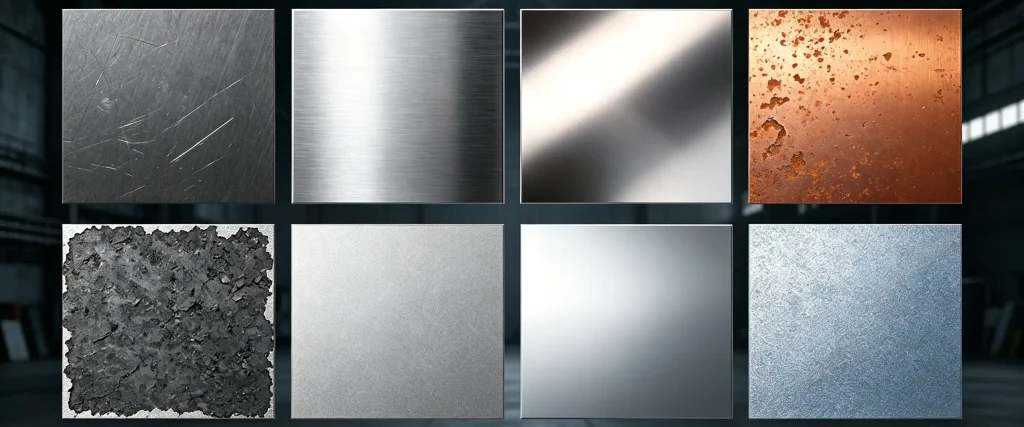
II. Why Is CVD Important in Tube Furnaces?
1. CVD Enables Controlled Thin-Film Growth
One of the most important advantages of CVD is its ability to produce thin films directly on a substrate.
Depending on the precursor chemistry and process conditions, CVD can be used to prepare materials such as:
- Graphene
- Carbon nanotubes
- Semiconductor films
- Ceramic coatings
- Two-dimensional materials
- Functional nanomaterials
Zum Beispill, NIST describes graphene CVD using a carbon feedstock over a copper surface at high temperature in a reducing, hydrogen-rich atmosphere. The process relies on controlled decomposition of the feedstock at the substrate surface.
This makes the tube furnace much more than a heating device. It becomes the controlled reaction environment in which the deposited material is created.
2. Precise Temperature Control Determines Deposition Quality
Temperature is one of the most influential parameters in a CVD process.
The substrate, precursor, and reaction zone must often be maintained within a relatively narrow temperature range. Changes in temperature can affect:
- Precursor decomposition
- Surface reaction kinetics
- Nucleation
- Deposition rate
- Film thickness
- Crystal structure
- Material morphology
This is why high-quality CVD tube furnaces often use independent temperature zones.
1600°C multi-zone CVD tube furnace uses independently controlled heating zones so that different sections can be assigned different temperatures for processes such as preheating, reaction, an Ofkillung. The product specifies temperature uniformity of ±1°C.
A multi-zone design can therefore provide much greater process flexibility than a single-zone furnace when the reaction requires a defined temperature profile.
3. Multi-Zone Heating Is Especially Important for CVD
A major reason researchers choose multi-zone tube furnaces for CVD is that the precursor region and deposition region may require different thermal conditions.
Zum Beispill:
Upstream Zone → Precursor heating or vaporization
Middle Zone → Reaction / deposition
Downstream Zone → Controlled cooling or additional reaction
The temperature gradient can influence the transport and reaction of precursor species inside the tube.
existing multi-zone CVD equipment specifically provides independent temperature control for different heating sections. This allows the user to establish separate thermal conditions for preheating, reaction, and cooling rather than forcing the entire furnace to operate at one temperature.
For advanced material research, this is often one of the key reasons to select a multi-zone furnace.
4. Atmosphere Control Prevents Unwanted Reactions
Temperature alone is not enough for a reliable CVD process.
The gas environment surrounding the substrate is equally important.
Depending on the material system, CVD may use gases such as:
- Argon
- Nitrogen
- Hydrogen
- Oxygen
- Carbon-containing precursor gases
- Other process-specific gases
A controlled atmosphere helps establish the chemical environment required for the deposition reaction and can reduce unwanted oxidation or contamination.
Tube furnaces are well suited to this type of work because the process tube can be sealed and equipped with gas inlet and outlet systems. Controlled-atmosphere tube furnaces can regulate gas composition, pressure, and oxygen partial pressure for high-temperature chemical reactions.
5. Vacuum Control Improves Process Stability
Many CVD processes require more than atmospheric-pressure operation.
Vacuum systems can be used to:
- Remove residual air
- Reduce contamination
- Establish controlled pressure
- Improve atmosphere exchange
- Prepare the chamber before precursor introduction
The tube furnace becomes a sealed reaction chamber once the process tube and flanges are properly connected.
6.What Are the Main Components of a CVD Tube Furnace?
A complete CVD tube furnace normally integrates several systems.
Heating System
The heating system creates the reaction-zone temperature required for precursor decomposition and surface deposition.
Important specifications include:
- Maximum temperature
- Working temperature
- Heizungsquote
- Temperature uniformity
- Number of heating zones
Process Tube
The furnace tube forms the actual reaction chamber.
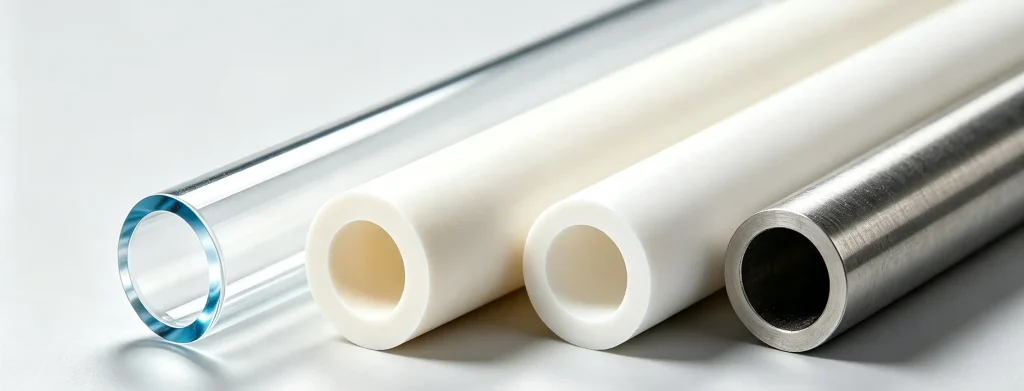
Common tube materials include:
- Quartz
- Héich Puritéit Aluminiumoxid
- Other specialized ceramics
The choice depends on temperature, atmosphere, chemical compatibility, and contamination requirements.
Gas Delivery System
The gas system introduces carrier gases and process gases into the furnace tube.
It may include:
- Gas inlets
- Valves
- Flow meters
- Mass flow controllers
- Gas mixing systems
- Gas exhaust lines
Precise flow regulation is important because gas flow influences precursor concentration, residence time, mass transport, and deposition behavior. In CVD, precursor molecules reach the substrate through fluid flow and/or diffusion, while their reaction and residence time influence film growth.
Vacuum System
The vacuum system removes air or establishes the desired process pressure.
Typical components include:
- Vacuum pump
- Pressure gauge
- Pressure sensor
- Valves
- KF flanges
- Vacuum tubing
Temperature Control System
A programmable controller coordinates the heating process.
Advanced systems may provide:
- PID temperature control
- Multi-zone control
- Programmable heating curves
- Data recording
- Touchscreen operation
- Computer communication
The multi-zone CVD furnace supports programmable multi-temperature-zone operation and computer control through RS485/USB according to its published specifications.

7.What Materials Can Be Produced by CVD in Tube Furnaces?
CVD tube furnaces are widely used in advanced material research and production.
Graphene
Graphene is one of the most well-known applications of thermal CVD.
CVD can grow graphene films on suitable catalytic substrates such as copper. NIST’s 2024 work describes oxygen-free graphene CVD involving a carbon feedstock, typically methane, at temperatures above 1000°C in a hydrogen-rich reducing atmosphere.
This type of process highlights the importance of accurate thermal and gas control.
Carbon Nanotubes
CVD tube furnaces can also be used to synthesize carbon nanotubes.
A multi-zone configuration can be useful because catalyst activation, carbon-source decomposition, and nanotube growth may benefit from different thermal conditions.
Two-Dimensional Materials
CVD is increasingly used to produce two-dimensional materials such as:
- MoS₂
- WSe₂
- h-BN
The ability to independently control temperature zones, gas flow, pressure, and substrate environment makes tube-furnace CVD suitable for experimental development of these materials.
Semiconductor and Thin-Film Materials
CVD tube furnaces are also used for semiconductor-related material research, coatings, annealing, and thin-film deposition.
The controlled thermal environment can support processes where film thickness, composition, crystal structure, or interface quality must be carefully managed.
Single-Zone vs Multi-Zone CVD Tube Furnace
One of the most important purchasing decisions is whether a single-zone or multi-zone configuration is appropriate.
| Feature | Single-Zone CVD Furnace | Multi-Zone CVD Furnace |
|---|---|---|
| Temperature control | One main temperature zone | Independent temperature zones |
| Thermal profile | Relatively simple | Highly configurable |
| Precursor and substrate temperatures | Often similar | Can be independently controlled |
| CVD process flexibility | Moderate | Héich |
| Temperature-gradient experiments | Limited | exzellent |
| Advanced material research | Suitable for simpler processes | Better suited to complex processes |
A single-zone system can be sufficient when the substrate and precursor require approximately the same thermal environment.
Allerdéngs, when the process requires a temperature gradient or separately controlled upstream and downstream regions, a multi-zone system provides considerably greater flexibility. own CVD guidance identifies multi-zone temperature control as particularly useful for precursor heating and separate deposition conditions.
8.What Is CVD in a Tube Furnace?
CVD, or Chemical Vapor Deposition, is a process in which gaseous or vapor-phase precursors react or decompose at a heated substrate surface to form a solid coating or material.
In a tube-furnace CVD system, the reaction takes place inside a sealed furnace tube under carefully controlled thermal and atmospheric conditions.
A typical process includes:
Substrate Loading → Evacuation/Purging → Heating → Gas Introduction → Precursor Reaction → Film Growth → Cooling
The tube furnace provides the thermal environment, while the gas and vacuum systems establish the chemical environment required for deposition.
This combination is what makes a CVD tube furnace different from a conventional electric tube furnace. CVD processes require coordinated control of temperature, gas flow, pressure, and precursor chemistry.
III.CVD Tube Furnace Solutions from MeltingFurnace.net
The 1600°C Multi-Zone CVD Tube Furnace provides independent temperature-zone control, vacuum capability, atmosphere control, 99% alumina tube construction, and applications including graphene, carbon nanotubes, 2D materials, advanced ceramics, battery materials, metal-powder reduction, catalysts, and nanomaterials.
The Double-Layer CVD Sliding Horizontal Tube Uewen uses three independently controlled temperature zones, high-purity quartz tubing, vacuum and gas-control systems, and a sliding structure designed to facilitate sample loading, unloading, tube cleaning, and maintenance. It is positioned for graphene, 2D materials, carbon nanotubes, semiconductor materials, and nanomaterial research.
The website also provides multi-zone laboratory tube furnace configurations for CVD, Diffusioun, oxidation, powder sintering, and functional-material preparation. One listed 1000°C system uses multiple independently controlled heating zones with a quartz tube and vacuum/atmosphere capability.
For customers developing a new CVD process, the correct configuration can be selected according to:
Temperatur + Number of Zones + Tube Material + Gas Chemistry + Vakuum Niveau + Sample Size + Process Automation
This approach is generally more effective than selecting equipment based on maximum temperature alone.
IV. Conclusion
The importance of CVD in tube furnaces comes from the ability to combine precise thermal control with a controlled chemical environment. CVD tube furnaces provide the temperature uniformity, gas control, vacuum capability, and sealed reaction space required for thin-film deposition and advanced material synthesis.
For graphene, carbon nanotubes, 2D materials, semiconductor films, Keramik, and other functional materials, a suitable CVD furnace can provide significantly better control over deposition conditions and process repeatability.
When choosing a system, buyers should evaluate the complete process—including temperature zones, tube material, gas delivery, eidel, pressure, sample size, and safety requirements—rather than focusing on furnace temperature alone.
Contact MeltingFurnace.net to discuss your CVD process and get a tube furnace configuration matched to your material, Temperatur, atmosphere, and deposition requirements.
Klickt “Ufro en Devis” eng personaliséiert Léisung ze kréien.
V.FAQ
1.What is the role of CVD in a tube furnace?
CVD uses the controlled thermal and atmospheric environment inside a tube furnace to convert gaseous or vapor-phase precursors into solid films or advanced materials on a substrate. The furnace provides controlled temperature, while the gas and vacuum systems establish the reaction environment.
2.Why is a multi-zone tube furnace important for CVD?
A multi-zone furnace allows different parts of the process tube to operate at different temperatures. This is useful when precursor heating, chemical reaction, and substrate deposition require different thermal conditions.
3.What materials can be grown using CVD in a tube furnace?
CVD tube furnaces can be used for graphene, carbon nanotubes, 2D materials, semiconductor films, ceramic coatings, and other advanced materials. specifically lists graphene, CNTs, 2D materials, nanomaterials, and thin-film applications for its CVD tube furnace systems.
4.Why are gas flow and atmosphere control important in CVD?
Gas composition and flow affect precursor transport, residence time, chemical reactions, and deposition behavior. Controlled atmosphere systems can also reduce unwanted oxidation or contamination and establish repeatable process conditions.
5.What tube material is best for a CVD furnace?
Quartz and high-purity alumina are common choices, but the best tube material depends on the process temperature, precursor chemistry, atmosphere, vacuum requirements, and contamination sensitivity.offers both quartz and high-purity alumina configurations for different CVD applications.
Fournisseur
Luoyang Anjing Intelligent Equipment Co., Ltd. ass eng Entreprise déi der Fuerschung gewidmet ass, Entwécklung, Produktioun, Ofsaz, an technesch Servicer vun Hëtzt Behandlung Equipement wéi héich-Temperatur elektresch Schmelzhäre. Mir produzéiere Labo, eidel, industriell, a Mëttelfrequenz Uewen, Deckt en Temperaturberäich vun -100 ℃ bis 2600 ℃, Déngscht Industrien wéi nei Energie, semiconductors, an fortgeschratt Materialien. Mir kënne personaliséiert Léisunge baséieren op spezifesch Atmosphär, ultra-héich Temperatur, an intelligent Kontroll System Ufuerderunge. W.e.g. kontaktéiert eis wann Dir interesséiert sidd.