Luoyang Anjing Intelligence Equipment er en global leder inden for højtemperatur elektriske ovne



How Large Diameter Tube Furnace Enables Continuous High-Volume Production
With the trend of high-temperature manufacturing gradually upgrading towards continuous and large-scale production, large-diameter Rørovn are transforming from “specific equipment” into “core nodes of production lines.” Their value lies not only in their increased size but also in the improved process stability, capacity release, and system integration capabilities brought about by structural enlargement. This equipment is playing a crucial role in fields such as new energy materials, advanced ceramics, and powder processing.
I. Product Overview
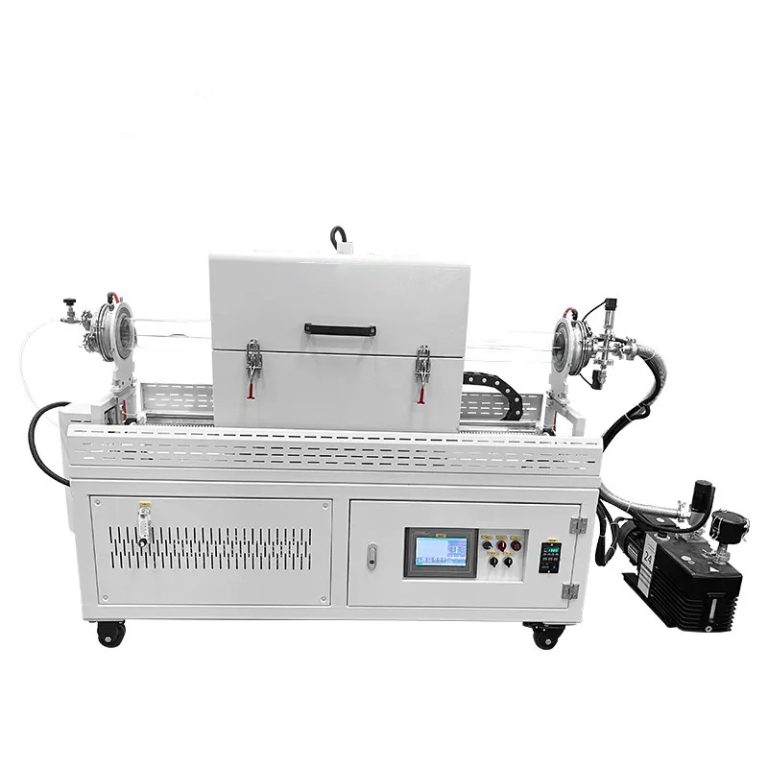
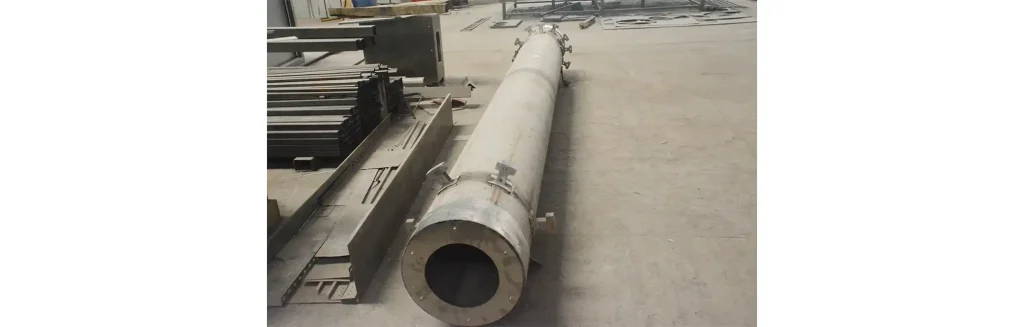
Large-diameter tube furnaces are industrial heating equipment used for high-temperature material processing. Their core feature is their large heating tube diameter. Compared to traditional tube furnaces, the tube diameter of these furnaces is typically over 150mm, with some industrial models reaching 600mm or even larger.
This structural design gives them numerous practical advantages in continuous or batch production scenarios. The design philosophy of industrial furnaces emphasizes a comprehensive balance between processing capacity, process control, and operational economy, and large-diameter tube furnaces achieve effective breakthroughs in all three dimensions.
For large-scale production requiring high-temperature processing, this type of equipment is becoming an increasingly important choice. Whether it’s continuous sintering of powder materials or single-batch heat treatment of large-sized components, large-diameter tube furnaces can provide processing throughput that traditional small tube furnaces cannot achieve.
| Large batch processing capacity | Allows placement of larger workpieces or more materials per run; suitable for batch continuous production, increasing output per unit time |
| Compatibility with large-sized or irregular-shaped parts | Can process rods, plates, powder sintered bodies, or irregular parts that require suspension heating without splitting or multiple feeding operations |
| More stable gas flow distribution | Large cross-section reduces flow resistance; inert, reducing, or oxidizing atmospheres distribute more evenly, improving batch consistency |
| Long effective uniform temperature zone | With properly arranged heating zones, axial and radial temperature differences are minimized; ideal for processes requiring strict temperature uniformity (f.eks., keramisk sintring, metal heat treatment) |
| Lower heat loss per unit volume | Given the same insulation thickness, the volume-to-external-surface-area ratio increases, reducing the proportion of heat loss; more energy-efficient during long-term operation |
| Sufficient space for loading and unloading | Can integrate with automatic pushers, roller mechanisms, or trolley systems for semi- or fully automatic loading/unloading, reducing labor intensity and operational risks |
| Adaptability to multi-step process integration | Can interface with upstream/downstream equipment (f.eks., continuous pusher kilns, cooling tunnels) to build continuous production lines, reducing intermediate material transfer |
| Short and accessible cleaning path | Large inner diameter allows use of specialized brushes or air purging systems for decoking and dust removal, extending tube life and reducing downtime |
| Better stress distribution in tube wall | Thick-walled, large-diameter structures offer greater thermal shock and mechanical impact resistance, suitable for frequent temperature cycling or mildly vibrating industrial environments |
II. Tube Furnace Product Features and Advantages
- Processing Capacity and Production Adaptability
The core structural advantages of large-diameter tube furnaces directly lead to increased processing capacity. The larger cross-sectional area of the tube cavity allows for a greater volume of material to pass through per unit time, or accommodates larger individual workpieces. For example, increasing the tube diameter from 50mm to 200mm increases the cross-sectional area by 16 times, resulting in a significant increase in theoretical throughput.
This feature helps improve single-batch or continuous processing throughput, adapting to the pace requirements of large-scale production. Simultaneously, its structure facilitates the processing of materials in specific forms—powders, granules, lumps, and even irregularly shaped parts can all obtain sufficient heat treatment space within the large diameter.
On continuously fed production lines, the large diameter reduces the flow resistance of materials within the tube. Whether relying on gravity sliding, mechanical pushing, or pneumatic conveying, a larger cross-section means a lower risk of material blockage and smoother material flow, which is beneficial to process stability.
- Process Control and Thermal Environment Quality
The larger tube cavity space, combined with a reasonable heater layout and airflow design, helps to create a more uniform temperature field distribution within the effective heating zone. This is crucial for ensuring uniform heat treatment within a batch or along the material’s path, a key condition for guaranteeing product quality stability.
Spatial constraints also allow for more flexible arrangement of process gas inlets and outlets, temperature measurement points, and observation ports. For example, multiple thermocouples can be installed at different locations on the furnace tube to monitor temperature field changes in real time; multiple gas inlets can be set up to achieve segmented atmosphere control along the material’s path.
For processes requiring specific gas environments, larger spaces facilitate sufficient gas-material contact and maintain atmosphere stability. Airflow avoids wall effects due to narrow tube cavities, resulting in more uniform powder agitation and distribution within the airflow.
- Operational Economics and Maintenance Advantages
Increased processing capacity means potentially fewer equipment units or shorter cumulative uptime for the same output target. One large-diameter unit can replace three to five small tube furnaces, resulting in significant benefits in terms of space utilization and total energy consumption.
Structural design typically considers durability in industrial environments, employing materials adapted to high temperatures and process atmospheres. Common materials for furnace tubes include quartz, corundum, silicon carbide, and high-temperature alloy steel, selected based on the maximum operating temperature and atmospheric corrosivity.
The large maintenance space facilitates the inspection, cleaning, and replacement of critical components such as internal refractory materials and heating elements. Maintenance personnel can more easily access the interior of the furnace tubes, which is particularly important for processes handling volatile substances or requiring regular removal of deposits, helping to reduce maintenance difficulty and downtime.
- System Integration and Adaptability
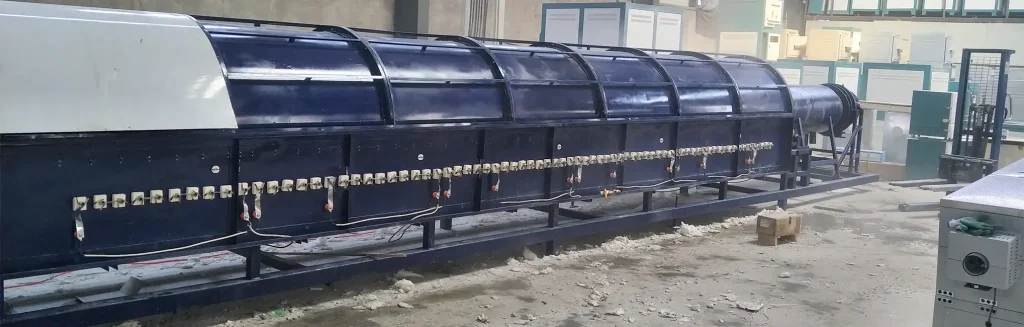
In industrial production lines, large-diameter tube furnaces exhibit excellent system integration adaptability. Their structure facilitates mechanical connection and process integration with upstream feeding devices and downstream cooling or collection systems, forming a continuous automated production line.
The equipment design allows for customization to meet specific process requirements. For example, tilting mechanisms can be configured for gravity-assisted feeding, multiple temperature zones can be set for temperature gradient control, and vibration devices can be added to improve powder flow. This adaptability enables it to serve a diverse range of industrial heat treatment applications.
III. Two Key Product Topics
- Mechanism for Achieving Continuous High-Throughput Production
Larger pipe diameter is not merely about being “larger,” but about restructuring the production rhythm. In continuous feeding mode, the resistance of materials passing through the furnace tubes is reduced, resulting in smoother transport, which is particularly important for powder, granule, or carrier transport. Stable flow means more controllable residence time, thus ensuring the integrity of the reaction or heat treatment.
From a capacity perspective, as the throughput of a single unit increases, companies can reduce the number of parallel units. This not only saves space but also reduces overall energy consumption and management complexity. This is of practical significance for the current industrial system that emphasizes “output per unit of energy consumption.”
- Synergistic Design of Temperature Uniformity and Atmosphere Stability
Achieving temperature uniformity in a large space is not easy, which is precisely where the design value lies. Through zoned heating, independent temperature control, and thermal field simulation optimization, temperature differences can be controlled within a small range, thereby ensuring product consistency.
Meanwhile, atmosphere control becomes another key variable. The large pipe diameter space allows for more sufficient diffusion and mixing paths for gases, making the reaction environment more stable. For example, in processes requiring inert gases or reducing atmospheres, this stability directly impacts product performance.
Modern large-diameter tube furnaces are incorporating more sensors and data feedback systems to achieve real-time temperature and atmosphere control. This “data-driven thermal control” is becoming the direction for industry upgrades.
IV. Tube Furnace Product Applications
- Continuous Sintering of Lithium-ion Battery Positive and Negative Electrode Materials: The industrial production of battery materials such as lithium iron phosphate, ternary materials, and graphite anodes requires powders to undergo high-temperature sintering for several hours under a protective atmosphere.
- Catalyst and Chemical Powder Calcination: Processes such as catalyst carrier activation, molecular sieve calcination and demolding, and carbonization activation of carbon materials require high-temperature treatment and strict atmosphere control. Large-diameter tube furnaces, with their sealed cavities, are suitable for handling volatile products, while the larger diameter allows the powder to form a thinner layer within the furnace tube, resulting in more uniform heating.
- Advanced Ceramics and Powder Metallurgy: The synthesis or pre-sintering of ceramic powders such as silicon carbide, aluminum nitride, and zirconium oxide often requires tube furnaces to provide a uniform temperature field and protective atmosphere. Large diameter tubes allow for the direct loading of entire bags or drums of powder, reducing the labor intensity of repackaging operations. For the debinding and sintering steps of metal injection molding (MIM), large diameter tubes can accommodate batches of preforms.
- Specialty Metal Heat Treatment and Annealing: Annealing, solution treatment, or stress relief of metal products such as stainless steel pipes, titanium alloy bars, and magnetic materials
- Electronic Waste and Precious Metal Recycling: Pyrolysis or chlorination volatilization processes for recovering precious metals from waste circuit boards and catalysts require equipment to operate long-term in atmospheric or chlorine environments. The large cross-section of large-diameter tube furnaces reduces the risk of flue gas blockage and also facilitates manual cleaning of slag or residues.
V.Supplier
Luoyang Anjing Intelligent Equipment Co., Ltd. is an enterprise dedicated to the research, development, production, sales, and technical services of heat treatment equipment such as high-temperature electric furnaces. We produce laboratory, vacuum, industrial, and medium-frequency furnaces, covering a temperature range from -100℃ to 2600℃, serving industries such as new energy, halvledere, og avancerede materialer. We can provide customized solutions based on specific atmosphere, ultra-high temperature, and intelligent control system requirements. Please feel free to contact us if you are interested.