Luoyang Anjing Intelligence Equipment er en global leder inden for højtemperatur elektriske ovne



Can Tube Furnace Also Be Used For Quenching? A Sliding Track Design Allows For “Instantaneous” Rapid Cooling Of Samples.
Traditionally, tube furnace are primarily used for sintering, udglødning, atmosphere heat treatment, and materials research, while quenching is typically accomplished using dedicated quenching furnaces or heat treatment production lines. However, with the increasing demands for new materials research and laboratory heat treatment, a sliding-track quenching tube furnace integrating heating, atmosphere protection, and rapid cooling is attracting growing attention from research institutions and industrial laboratories.
This type of equipment, through a combination of furnace movement, rapid purging, and a liquid quenching system, enables rapid transfer of samples from the high-temperature zone to the cooling medium, significantly shortening the high-temperature residence time and making the quenching processes for metals, keramik, and new materials in laboratory environments more precise and controllable.
I. Product Overview
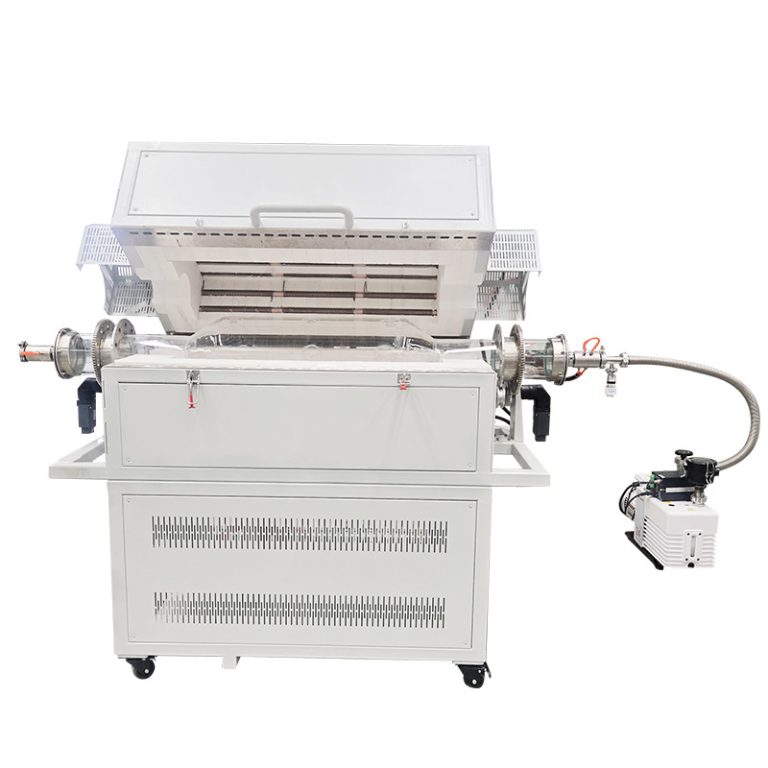
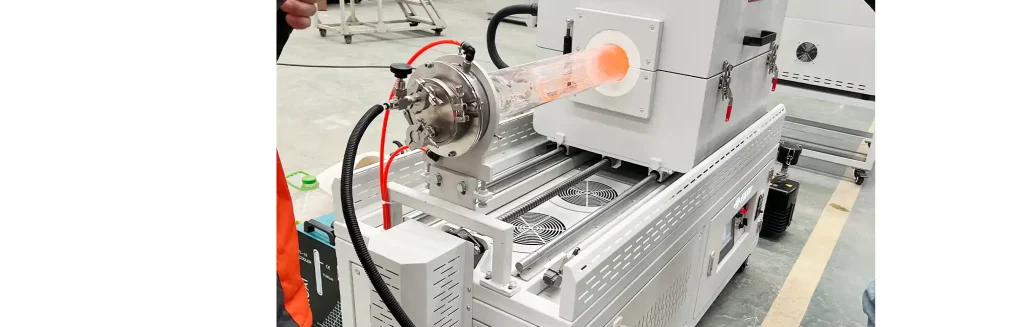
The sliding track quenching tube furnace is a high-temperature experimental device specifically developed for rapid heat treatment processes. The biggest difference between it and ordinary tube furnaces lies in its automatic furnace body translation structure and dedicated quenching and cooling system. After the program finishes running, the furnace body automatically moves out of the heating zone, simultaneously activating gas purging and rapid cooling functions. For materials requiring even higher cooling rates, the sample can be directly pushed into the coolant via the sliding track mechanism to complete the quenching.This design solves the problem of “easy heating, difficult rapid cooling” in traditional laboratory heat treatment.
II. Product Features and Advantages
- Sliding Track Design Enables “Second-Level” Transfer
This is the core feature of the equipment. After the electric furnace program completes, the furnace body automatically moves to one side along the track, simultaneously opening the inlet and outlet valves, and initiating rapid purging on the outside of the furnace tubes to accelerate cooling. The transfer process from the high-temperature zone to the cooling tank is completed within 1-2 seconds. Compared to the traditional tube furnace operation method that requires manually opening the flange and removing the sample, the time is reduced by an order of magnitude.
For quenching processes, the shorter the transfer time, the more effectively non-martensitic transformation can be suppressed, ensuring that the hardness meets the standard after quenching. For solution treatment of austenitic stainless steel at 1200℃, if the transfer time exceeds 5 seconds, carbides will precipitate at the grain boundaries, significantly reducing corrosion resistance. The sliding track design controls the transfer time to 1-2 seconds, meeting the requirements of most rapid cooling processes.
- Dual Furnace Tube Configuration to Adapt to Different Process Requirements
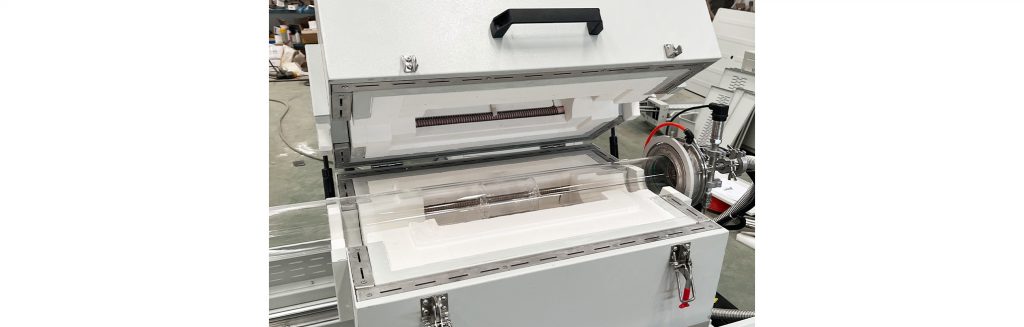
The equipment is equipped with two furnace tubes: one quartz tube and one high-temperature nickel-based alloy tube. Quartz tubes are suitable for conventional ceramic sintering and powder heat treatment, offering high transparency and good chemical stability. Nickel-based alloy tubes are heat-resistant and high-strength, suitable for quenching processes requiring rapid movement or contact with cooling media. Both tubes are 100mm in diameter and 1500mm in length, perfectly matching the furnace system, allowing users to choose the appropriate one based on their specific process.
- Cooling Tank + Vacuum Butterfly Valve for Precise Material Discharge Quenching
A liquid storage tank is located at the right end of the furnace tube, which can be filled with water or cooling oil as the quenching medium. It is equipped with a DN80 high-vacuum butterfly valve. During operation, the sample is heated on the left side of the furnace tube. Once the temperature reaches the set value, the butterfly valve opens while the furnace body moves, quickly pushing the material from the left side of the furnace tube into the cooling tank on the right. The cooling tank can be removed when not in use, restoring the furnace to its normal tube furnace function.
- Temperature Control Accuracy and Temperature Uniformity
Temperature control accuracy ±1℃, furnace temperature uniformity ±1℃ (depending on the size of the heating chamber), heating rate adjustable from 1℃/h to 15℃/min. 50-segment programmable control function, combined with Xiamen Yudian’s high-precision 8-series temperature controller, supports complex multi-segment heating and cooling curves. The furnace chamber uses high-purity alumina fiberboard, furnace body temperature ≤45℃, providing excellent energy saving and insulation, and ensuring a safe operating environment.
- Vacuum and Atmosphere Compatibility, Controllable Quenching Environment
Equipped with a 2L/S vacuum pump, the sealing flanges at both ends use a double rubber ring design, allowing for vacuuming or the introduction of a protective atmosphere. The quenching process can be carried out under an inert atmosphere, preventing oxidation of high-temperature samples during cooling. This design extends the quenching process from “only possible in air” to “controlled atmosphere quenching,” which is significant for easily oxidized materials (such as copper alloys and titanium alloys).
| Rapid quenching | Cooling rate ≥200℃/min. Furnace body slides + internal/external purge cooling for true quenching effect |
| Dual-tube configuration | Includes quartz tube (transparent for observation) and nickel-based alloy tube (thermal shock resistant), switchable as needed |
| Liquid quenching function | Equipped with cooling tank (water/oil) at the right end; sample can be pushed into liquid under protective atmosphere for rapid cooling without oxidation |
| Automatic program control | 7-inch touchscreen + 50-segment programming; temperature, sliding, and quenching are fully automated for excellent process repeatability |
| Large tube diameter & high power | Φ100mm tube + 8KW power; handles larger workpieces with fast heating and uniform temperature field |
| Multi-functional | Serves as standard tube furnace, vacuum/atmosphere furnace, gas quench furnace, and liquid quench furnace – saves equipment investment |
| Safe & reliable | Furnace surface temperature ≤45℃; double O-ring seals ensure good vacuum retention; thick insulation saves energy |
| Flexible & detachable | Cooling tank can be removed when not in use, restoring standard tube furnace configuration with no extra space occupation |
III. Two Important Topics Regarding the Product
- The Fundamental Difference Between Sliding Rail Rapid Cooling and Traditional Quenching Methods
Traditional Tube Furnace Quenching Operation: High-temperature holding ends → Heating power off → Flange opened → Furnace tube removed → Sample taken out → Cooling medium added. During this process, the time for the sample to move from the high-temperature zone of the furnace tube to the cooling medium is typically 10-30 seconds.
Sliding Rail Rapid Cooling Operation: Program completed → Furnace body automatically moves → Butterfly valve opened → Material pushed into the cooling tank. Transfer time is 1-2 seconds. The difference is not an order of magnitude, but rather the difference between “successful quenching” og “failure to quench.”
- Why Does Rapid Cooling Determine the Final Material Properties?
The microstructure of many materials is not formed during the heating stage, but rather determined during the cooling process.Taking steel as an example, rapid cooling of austenitic structures at high temperatures can form martensite, significantly improving hardness and wear resistance. Insufficient cooling may lead to the formation of pearlite or bainite, altering material properties.
Traditional laboratory tube furnaces typically employ natural cooling, which often requires a lengthy time to reach the critical phase transformation temperature, failing to meet stringent quenching requirements.Sliding track quenching tube furnaces, by shortening sample exposure time, enable cooling rates exceeding 200°C/min, providing greater possibilities for controlling material microstructure.
IV. Product Applications
- Quenching of Metallic Materials: Quenching of materials such as carbon tool steel, alloy structural steel, and bearing steel requires rapid cooling from the austenitizing temperature to the completion of martensitic transformation. Sliding track quenching tube furnaces can complete the entire process from heating to quenching under a protective atmosphere, avoiding surface oxidation and decarburization.
- Solution Treatment of Stainless Steel: Austenitic stainless steel requires rapid cooling after heating to 1050℃-1150℃ to prevent carbide precipitation along grain boundaries, which can lead to intergranular corrosion.
- Solution and Aging of High-Temperature Alloys: Solution treatment of nickel-based high-temperature alloys (such as Inconel 718) requires rapid cooling from 980℃-1020℃, while aging treatment requires slow cooling.
- Annealing and Rapid Cooling of Magnetic Materials: Amorphous and nanocrystalline soft magnetic materials require rapid cooling after annealing to fix the fine grain structure and obtain excellent magnetic properties.
- Heat treatment of shape memory alloys: The shaping heat treatment of NiTi shape memory alloys requires high-temperature heating followed by rapid cooling to “lock in” the martensitic transformation temperature.
- Exploration of quenching process parameters and small-batch trial production: In universities and research institutes, sliding track quenching tube furnaces are ideal equipment for quenching process research.
V.Supplier
Luoyang Anjing Intelligent Equipment Co., Ltd. is an enterprise dedicated to the research, development, production, sales, and technical services of heat treatment equipment such as high-temperature electric furnaces. We produce laboratory, vacuum, industrial, and medium frequency furnace, covering a temperature range from -100℃ to 2600℃, serving industries such as new energy, halvledere, og avancerede materialer. We can provide customized solutions based on specific atmosphere, ultra-high temperature, and intelligent control system requirements. Please feel free to contact us if you are interested.